
Role-based training equips employees with the knowledge and skills relevant to their role. It is essential for performance. Engagement and better ROI on L&D efforts. Best practices include completing a thorough needs assessment before designing relevant programs. Next, monitor the courses regularly to collect actionable insights and keep them relevant.
Key Takeaways
- Role-based training provides skill training tailored to an employee’s role
- A needs assessment is the first step in identifying which roles to train for and the content to be learned
- Technology tools such as ops.work makes it easier to create and assign training courses
Healthcare facilities have diverse job roles, including clinical and non-clinical positions. These roles have different training requirements; therefore, they require different approaches to ensure training is relevant to their roles. Planning your training efforts is the first step toward aligning your L&D with different roles and organizational goals.
What is Role-Based Training?
Role-based training is a targeted training approach that equips employees with the specific knowledge and skills needed to succeed in their roles. It is an approach that tailors training content and delivery methods to different roles.
Here's a real-world example of role-specific training in a healthcare setting:
Regulatory bodies require all employees, including clinical and non-clinical roles, to receive HIPAA training. A one-size-fits-all approach would be inefficient, as employees in different roles have varying access to PHI.
Therefore, your HIPAA training content must align with the role-specific obligations as follows:
- All staff should receive training on foundational concepts of HIPAA, including risks, procedures, terminology, cybersecurity, and privacy.
- For administrative staff, HIPAA training should cover concepts such as handling paper and electronic records, secure printing and mailing, workspace privacy, and visitor inquiry management
- For IT staff, HIPAA training includes learning about encryption, backups, and access management, and risk monitoring to determine the security posture and handle security breaches
- For clinical roles, HIPAA training focuses on patient rights, secure documentation, secure use of devices to share sensitive information, and how to identify and report incidents.
- For leadership roles, HIPAA training covers compliance and risk management, incident management and response, compliance auditing, and communicating policy changes.
What are the Benefits of Role-Based Training?
Investing in role-based training ensures regulatory compliance by familiarizing employees with data privacy laws and specific security requirements for protecting sensitive information when handling employee and patient PHI.
Role-based training also offers other benefits, such as:
- Increased employee productivity and performance
- Better problem-solving abilities
- Higher engagement and retention rates
- Reduced L&D costs
What Are The Best Practices For Designing And Implementing A Role-Based Training Strategy?
Creating impactful training programs requires intentional planning, implementation, evaluation, and optimization. Here are the steps to design and implement role-based training.
Map the Needs that Make Training Important for Each Role
A needs assessment is the first step in creating training aligned with each role. During this step, you should conduct a skills analysis to identify the technical and soft skills specific to each role.
Here's a step-by-step guide on how to conduct an occupational needs analysis:
- Select the job role to analyze, for example, nurse practitioner or physician associate
- Create a detailed list of all the tasks performed for that role. Consult employees in that position, skill case studies, managers, and subject-matter experts (SMEs) to understand the key tasks performed in that role.
- Identify each skill, knowledge, ability, and competency required for each task in the job
- Conduct a performance review to identify skill gaps
- Collect employee feedback on areas they feel they might need more or less training on
Create Role-Based Training Programs
Engaging SMEs during the needs analysis allows you to identify what content role-based training should focus on to ensure that employees can meet their performance expectations.
It also lets you design the right course structure. You can structure employee training in two general ways: comprehensive or bite-sized learning.
Comprehensive learning goes in-depth into a subject. It is well-suited for onboarding training, helping your employees understand their roles and build their competency.
Bite-sized learning provides a quick reference for employees as they perform their day-to-day tasks. For example, an employee might consult microlearning content to determine what counts as an incident under HIPAA regulations.
Here are the best practices to keep in mind when creating role-based training courses:
- Tailor the course to the experience level of the employee
- Create role-specific training plans
- Integrate training into daily workflows where possible
- Include various formats to cater to different learning approaches
- Update content regularly to maintain relevance
Use Technology to Create and Deliver Training Content
Using employee training management software to create and deliver training to employees has the following benefits:
- It reduces training costs
- It allows employees to access relevant training at their own pace
- These systems provide a centralized location for all courses and resources that employees need to improve their skills
- They make it easier to update content, keeping your employee development efforts impactful across the organization
Ops.work is a dedicated LMS that enables you to create and deliver practical training, equipping your employees with the skills, knowledge, and abilities they need.
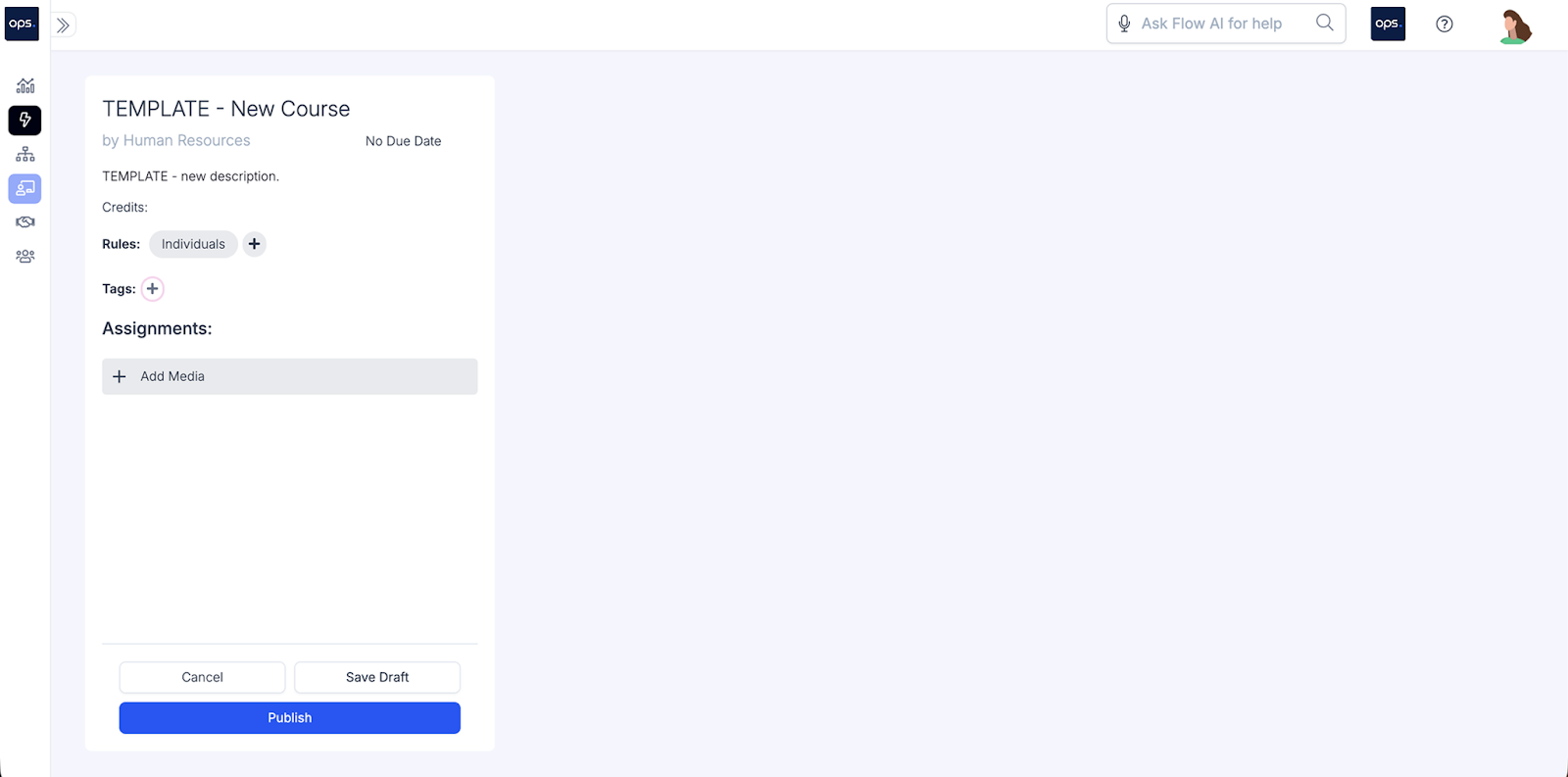
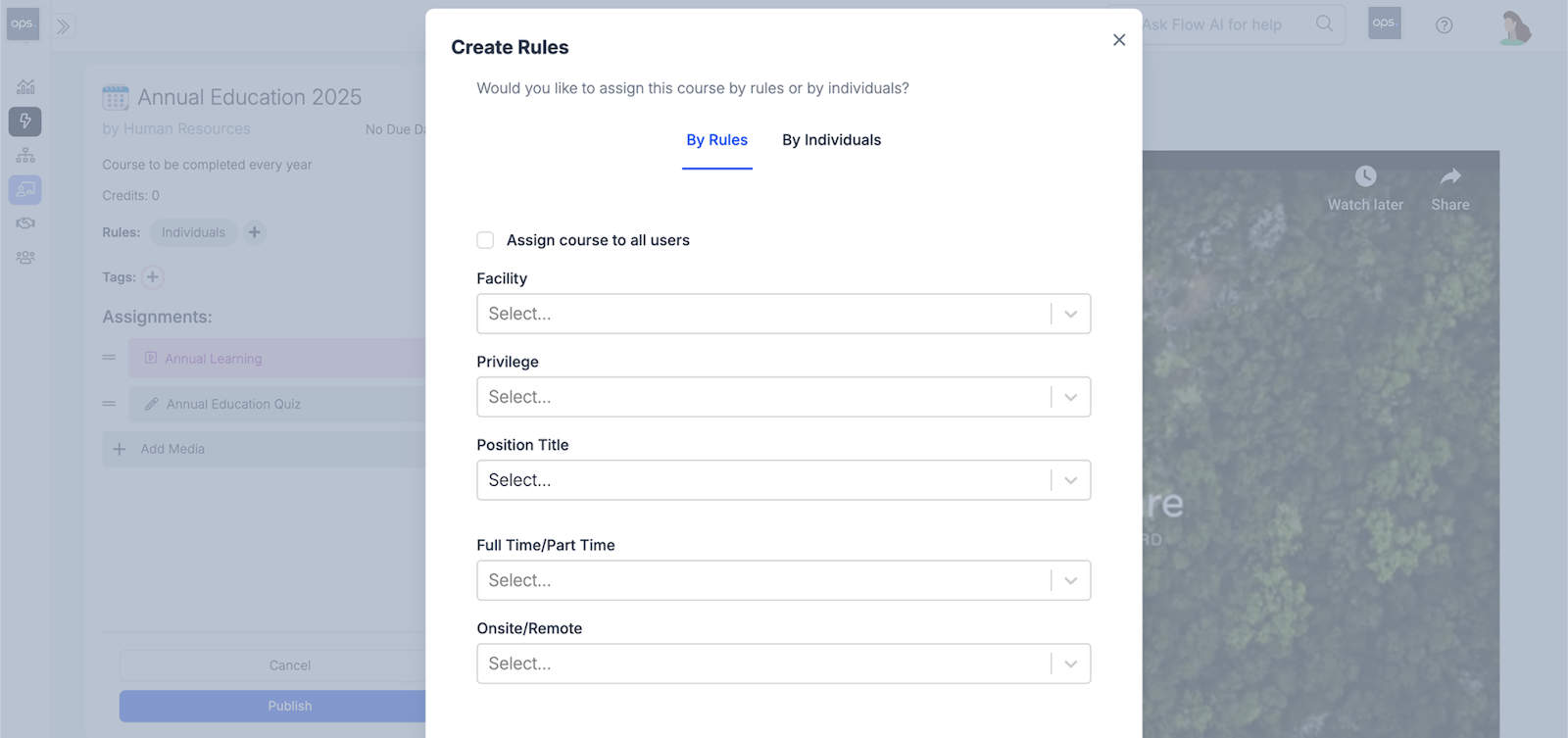
On the platform, you can set rules to assign courses based on job role. This automates the process and ensures all employees in a job role receive the same training.
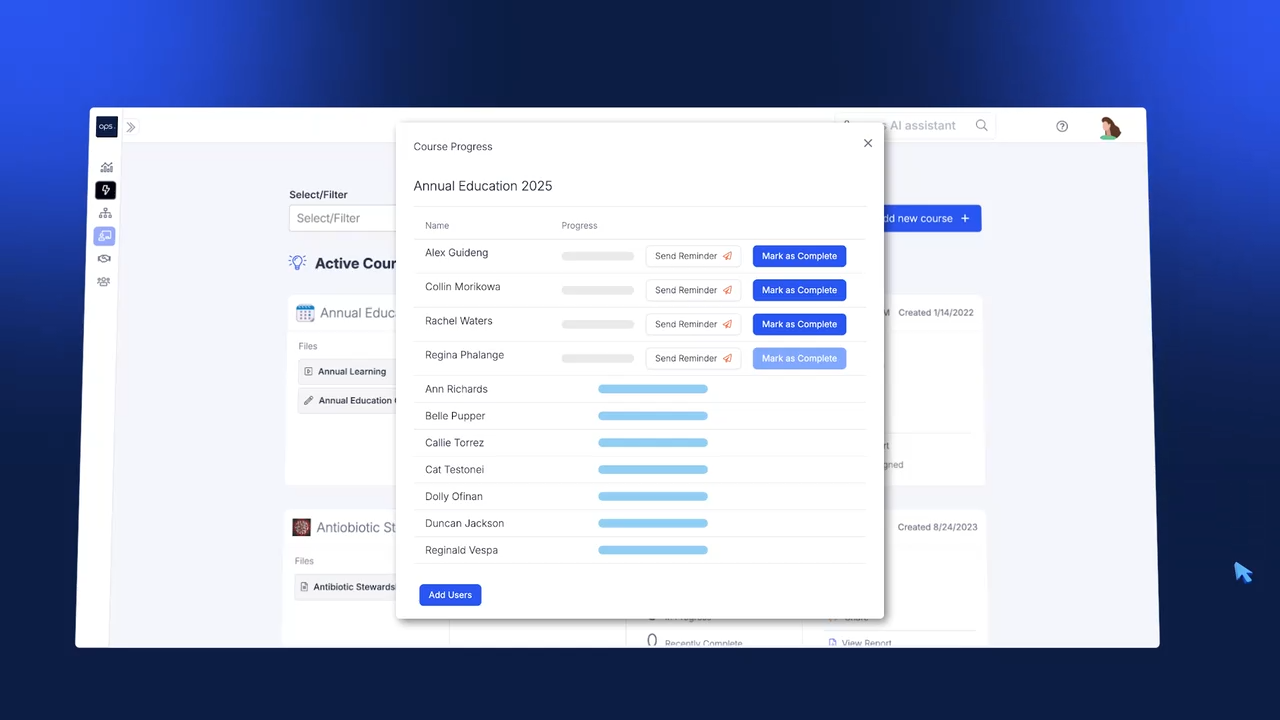
You can also track course completion rates and generate reports to measure the impact of your employee development efforts.
Monitor Key Metrics and Optimize Training
Monitoring key metrics helps you determine whether employees retain and apply the skills they have learned in their jobs. It also helps you identify gaps and opportunities to optimize your development efforts to align with your business strategy. Here are the best practices to measure and optimize training:
- Identify KPIs that matter most to your business. These may include course completion rates, knowledge retention and transfer, post-training performance, employee engagement, and turnover rates.
- Clarify when and how you will measure the impact of your employee development efforts
- Evaluate training often to ensure your courses are relevant to specific job roles
- Implement the lessons you learn
Conclusion
Tailoring your employee development efforts to job roles increases efficiency by ensuring employees develop the skills they require to succeed in their roles. Ops.work facilitates employee development by enabling you to create, assign, store, and monitor courses from a single centralized platform. Try our free plan to get started.
References
“Creating Training Appropriate to the Role.” Training Industry, 11 Jan. 2018, trainingindustry.com/magazine/jan-feb-2018/creating-training-appropriate-to-the-role/.
Lee, Zion. “Overcoming Challenges in Corporate Training: A Framework for Effective Training Initiatives.” Open Journal of Business and Management, vol. 11, no. 05, 1 Jan. 2023, pp. 2472–2487, www.scirp.org/journal/paperinformation?paperid=127999, https://doi.org/10.4236/ojbm.2023.115137.
Dubey, Reetika, et al. “Enhancing Employee Performance through Customized Training and Development Campaign -a Case of Accenture Solutions.” International Journal of Scientific Research in Multidisciplinary Studies, vol. Vol – 3, Issue – 1, Year - 2024, no. Vol – 3, Issue – 1, Year - 2024, 10 Jan. 2025, pp. 58–84, www.researchgate.net/publication/387877226_Enhancing_Employee_Performance_Through_Customized_Training_and_Development_Campaign_-a_Case_of_Accenture_Solutions.
Frequently Asked Questions
Role-based training is tailored to the specific skills they need to perform their roles and responsibilities. One-size-fits-all or generic training, on the other hand, is generic and designed for all employees, for example, basic security training.
- on-the-job training through shadowing, mentoring, and coaching employees
- Instructor-led education
- Elearning
- Simulation training, especially for risky procedures and environments
The 70-20-10 rule of learning breaks down how employees learn: 70% from doing their work, 20% through interactions with colleagues and peers, and 10% through formal training.
Metrics such as performance on assessment tests, training completion rates, employee engagement and retention rates, and customer satisfaction are indicators of effective role-based training.
Learning management systems are the common technology used in role-based training. Others that can be used include adaptive learning platforms, gamification, and microlearning tools.