
Onboarding is a comprehensive process that starts shortly after hiring and extends at least 90 days into a health educator’s employment. Done well, it benefits both the new hire and the organization by boosting job satisfaction, improving morale, and ensuring regulatory compliance.
Key Takeaways
- Onboarding health educators is a long-term process that begins before the new hires' first day and continues until they are sufficiently ready to handle their responsibilities.
- Providing role clarity from the beginning helps new hires know what they should be doing and how it contributes to organizational goals, increasing job satisfaction.
- Continuous feedback and ongoing support during and after onboarding help new hires feel appreciated and drive engagement.
Low morale and low employee satisfaction lead to higher turnover among new health educators. A well-designed staff integration program can streamline the process, enabling your employees to access the information and support they need to succeed.
What do Health Educators Do?
Health educators are professionals who work in healthcare organizations to educate patients and the community on various topics. They work alongside experienced clinicians as health advocates for the communities they serve.
Some of their responsibilities include:
- Assessing individual and community health needs
- Developing education programs to help translate medical knowledge for patients and caregivers, resulting in better patient care
- Overseeing health education programs provided by healthcare organizations
- Help individuals find the resources they need to improve their health and well-being
Why are Health Educator Onboarding Programs Important?
Onboarding builds on the first impression you built during educator recruitment. It signals to new health educators that you care about them and are willing to invest the time and resources they need to achieve full productivity.
A successful onboarding process for new hires benefits your organization in several ways:
- It boosts morale among new employees, thus improving job satisfaction rates and engagement
- It reduces burnout by clarifying expectations early and facilitating the gradual ramp-up of responsibilities, giving the new hire time to adjust before they can take up a full workload
- Effective onboarding programs enhance your recruitment and retention efforts by tracking key metrics to identify actionable best practices when hiring and integrating staff.
- A formal onboarding process facilitates compliance with regulatory requirements
What are the Stages of the Healthcare Onboarding Process?
Providing a personalized onboarding experience is the first step in retaining new employees after they accept your job offer. Work with your current onboarding team to develop a program that prepares your health educators for success from day one.
Use onboarding software such as ops.work to streamline repetitive tasks and reduce the time-to-productivity. Such a tool allows you to track different stages and the activities involved through comprehensive onboarding checklists.
Here are the four stages of integrating new staff and the activities in each stage:
Preboarding and Credentialing
Preboarding and credentialing happen before the employee reports for their first day. It includes activities such as:
- Collecting the required documentation to facilitate employment verification and credentialing.
- Completing employment forms for employment eligibility, tax withholding, employee benefits, and annual salary processing.
- Sending a welcome email with a brief introduction to the company
- Sending an orientation and training schedule
- Setting up the new hire's work station and provisioning the necessary IT systems
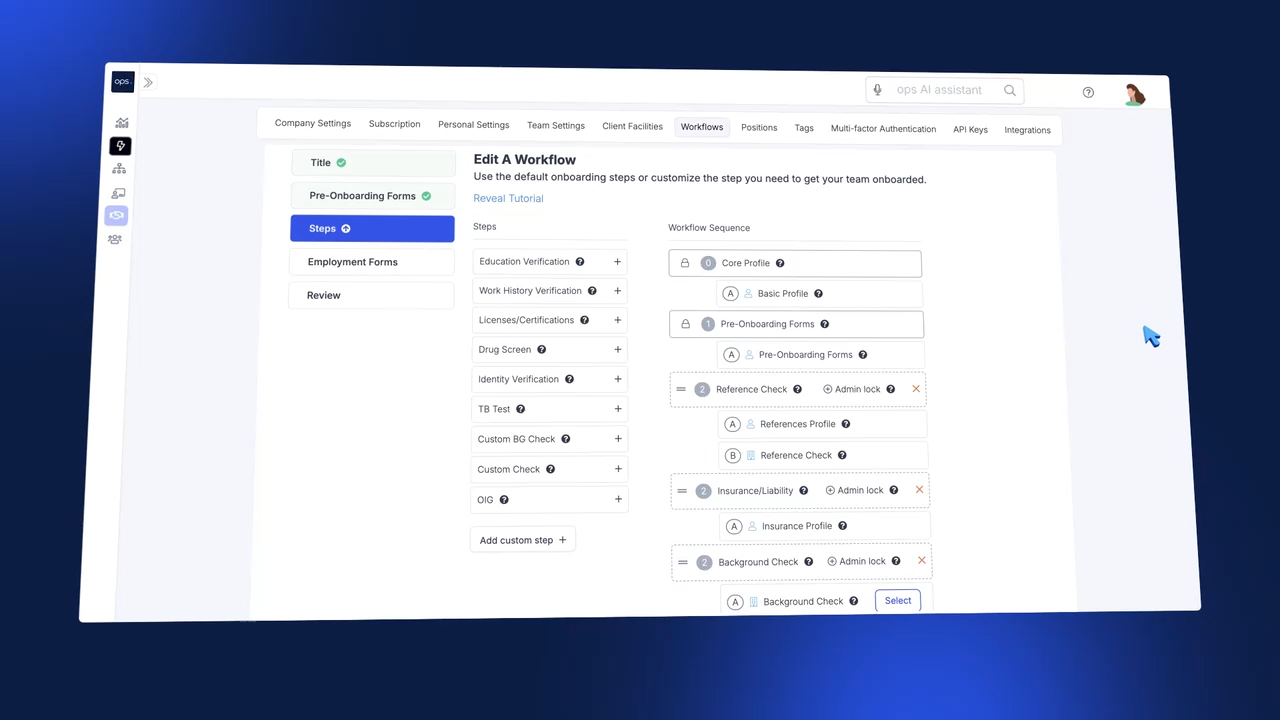
For a time-intensive process such as credentialing, you can use ops.work to create efficient workflows.
New Hire Orientation Process
The orientation period occurs on the first day through the first week of the health educator's new job. It involves:
- Completing HR documents, such as employee acknowledgment
- Introducing your organizational culture, structure, and policies
- Providing safety training
- Providing EHR and IT training
- Reviewing regulatory and internal policies
Compliance and Role-Based Staff Training
Training is one way to optimize how you integrate new staff. You should have a comprehensive training plan before the start date to ensure your health educators have the information they need about the required training from day one.
You should develop tailored training that covers key skills, competencies, and procedures. Here are some tips to keep in mind when training health educators:
- Create customizable training resources that can be tailored to different cohorts based on their skill level
- Create dedicated time for learning, especially for mandatory training courses such as OSHA and HIPAA, to protect your facility from legal and financial risks.
- Assign preceptors to new health educators to ensure your trainees have access to the support they need to navigate the work environment and their career
- Allow your new health educators to shadow more experienced professionals for on-the-job learning
Ongoing Support, Staff Retention, and Productivity Tracking
Supporting your health educators doesn't end after the first 90 days. You should provide your employees with the support they need to continue being successful and satisfied in their jobs. Here are tips for how to prevent employee dissatisfaction and turnover:
- Track quality measures to understand your processes, identify bottlenecks, and pinpoint potential areas for improvement.
- Liaison with medical education facilities to facilitate ongoing training and professional development opportunities
- Meet with employees throughout the transition process to assess their performance, clarify their roles, responsibilities, and their contribution to clinical work and patient satisfaction
- Send engagement surveys to allow employees to provide information about the integration process, including what they were dissatisfied with and their readiness to handle their responsibilities after the process.
Conclusion
Satisfied employees become a source of referrals for talent, which can help your facility address staffing challenges. Optimizing how you onboard is the first step in building a satisfied, productive, and engaged workforce. Tools such as ops.work provide various onboarding templates to help you organize your workflows and reduce the time it takes for employees to become productive. Sign up for our free plan to onboard hires better.
References
Azour, Lea, and Georgeann McGuinness. “From Great Resignation to Great Retention: Orientation as a First Step in Engaging Faculty Well-Being.” Academic Radiology, vol. 30, no. 10, 1 July 2023, https://doi.org/10.1016/j.acra.2023.06.007.
Vries, Neeltje de, et al. “Retaining Healthcare Workers: A Systematic Review of Strategies for Sustaining Power in the Workplace.” Healthcare, vol. 11, no. 13, 29 June 2023, pp. 1–29, pmc.ncbi.nlm.nih.gov/articles/PMC10341299/, https://doi.org/10.3390/healthcare11131887.
Catamco, Elma. “The ROI of Structured Onboarding in Healthcare.” American Medical Compliance, 24 June 2025, americanmedicalcompliance.com/general/the-roi-of-structured-onboarding-in-healthcare/.
Frequently Asked Questions
Orientation is a component of onboarding that typically happens on the first day or week on the job. Onboarding is the comprehensive process that begins immediately after recruitment and equips new staff with the skills and knowledge needed to succeed in their new roles.
The onboarding process typically lasts the first 90 days of an employee's new job. It may extend up to one year for more complex roles.
You can streamline onboarding using automation tools such as ops.work to automate workflows, create training materials, and track key metrics to measure the impact of your efforts.