
A structured medical social worker onboarding plan distributes onboarding activities into a 90-day calendar, allowing clarity for new social workers and onboarding teams. It ensures a smooth transition into independent case management in line with organizational goals.
Key Takeaways
- The first 30 days focus on orientation, the next 30 on skill development, and the final 30 days on full ramp-up to independent practice
- Your new medical social worker should receive a copy of the 30-60-90-day onboarding checklist for clarity on what they are expected to do
- Adopt technology tools to simplify the implementation of your onboarding plan through automated workflows, role-based training assessment, and automated feedback collection.
Medical social workers operate in various healthcare settings, including inpatient and outpatient clinics. They act as patient advocates, but their roles may vary depending on the settings in which they work. They are part of care teams in hospitals and home health facilities where they help with case management.
What are the Steps in the Medical Social Worker Onboarding Process?
A structured employee onboarding program facilitates a smooth transition, helping new hires adjust to their roles and become productive more quickly. Onboarding includes four main stages: preboarding, orientation, training, and feedback.
The preboarding phase begins after the recruitment process, but before the official start date. This stage offers your facility the opportunity to lay the foundation for a positive onboarding experience.
You can do this by:
- Sending and introduction email to let the new hire know more about the company
- Request the required documents to credential the new employee. Health professionals in social work require a master's degree, a state board license,
- Set up your new staff's workspace, IT equipment, and accounts they may need to perform their job
- Send a detailed calendar of the upcoming orientation sessions
- Conducting background and reference checks to ensure your new staff member is qualified to provide patient care
Creating checklists and automated workflows with ops.work onboarding software can ensure a smooth transition for new team members and help them feel welcome in your facility.
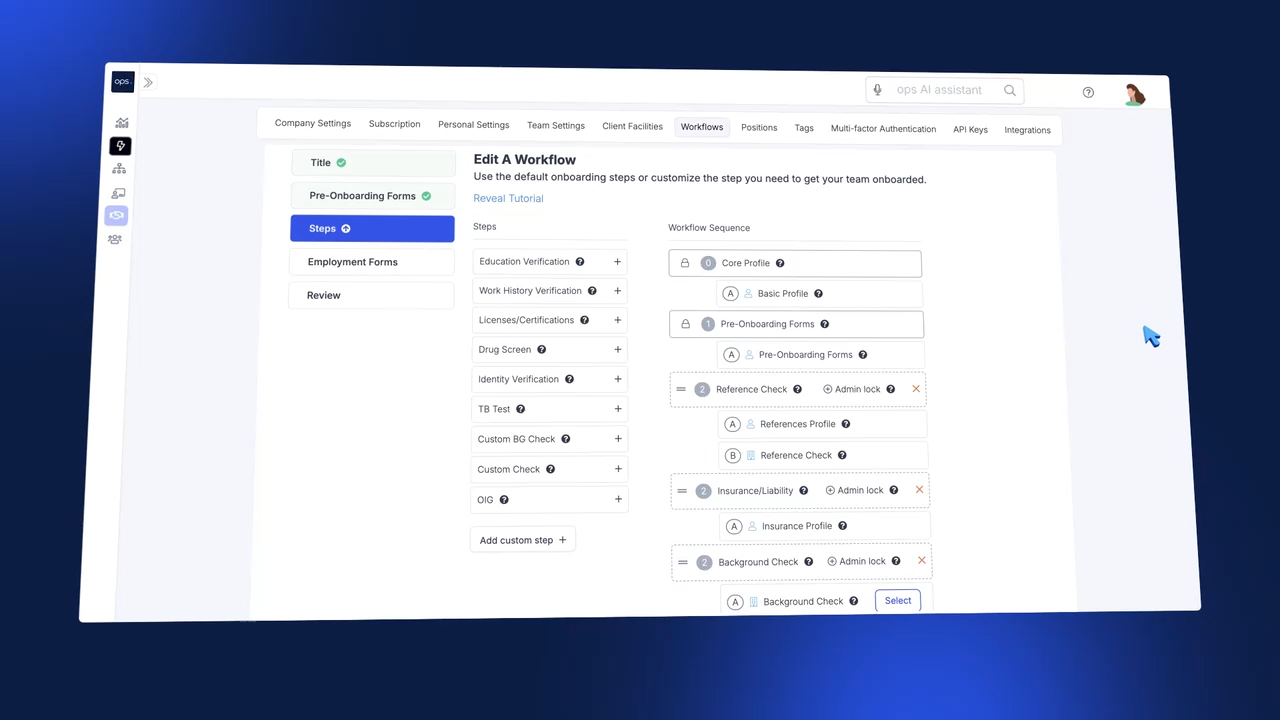
The orientation process lasts the first few days of starting a new job. It involves familiarizing the employee with your facility, their job, and colleagues. Some of the activities during this phase include:
- Providing an orientation and training schedule on the new employee's first day
- Filling out paperwork such as policy acknowledgments and non-disclosure documents
- Introducing them to the regulatory and internal policies and procedures that facilitate compliance and high-quality patient care
- Providing compliance training on patient data privacy and safety protocols
- Clarifying what their role, responsibilities, reporting requirements, and performance expectations are. Employees who understand their scope of practice have better engagement and performance outcomes.
- Introduce your organization's mission, vision, core values, and culture
- Provide a facility tour that includes an introduction to their colleagues
- Pair your hire with a mentor who acts as the go-to contact person when your staff needs support in their work or doesn't understand something about their new work environment
- Introduce your newly hired employee to your IT and EHR systems
- Introduce them to patients to facilitate better relationships with patients
Training is the third stage in onboarding new colleagues to your care team. Training helps new workers build confidence in their ability to excel in their new role. You should provide a range of training formats and content to prepare your worker for their role.
Here are tips to consider when training:
- Pair your worker with a more experienced clinician for hands-on training
- Create comprehensive modules to provide clinical training, case management, crisis resolution, de-escalation, and cultural sensitivity skills
- Personalize the training to different care workers based on their prior experience and education
- Use LMS tools to streamline your training efforts
You can use tools such as ops.work to customize and assign your role-specific courses and track employee completion rates.
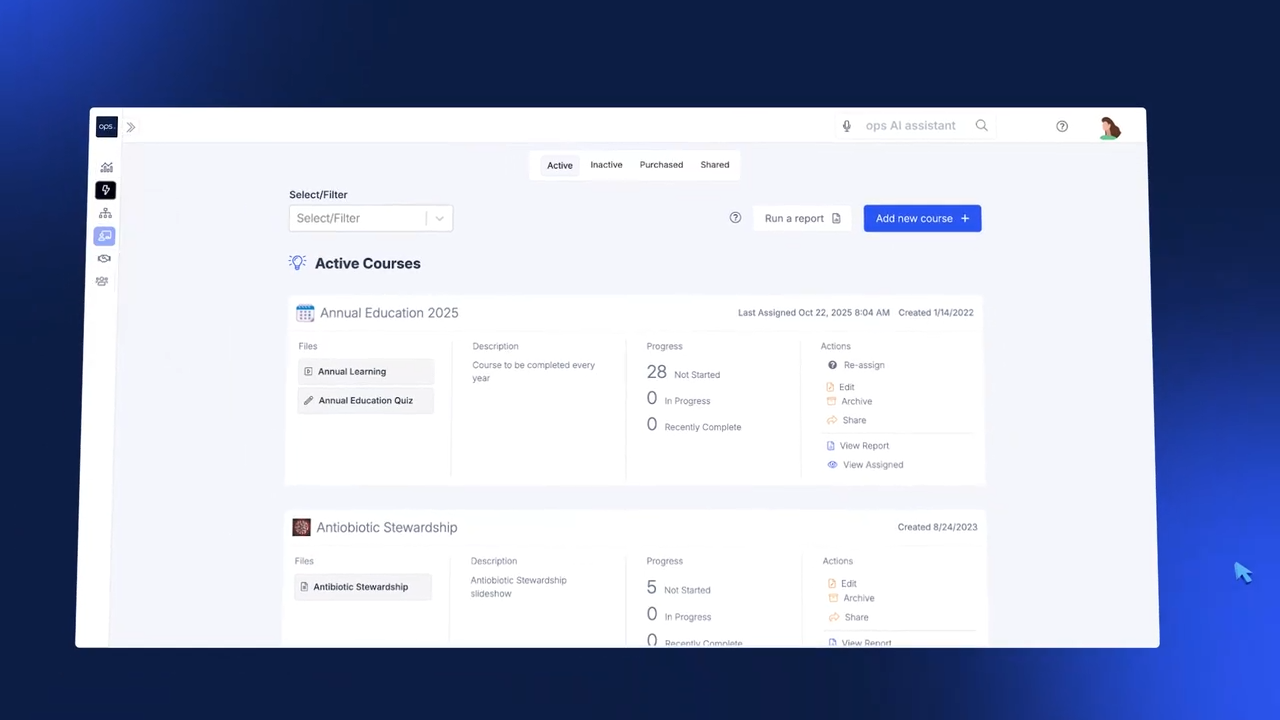
Training is an ongoing activity that lasts beyond the onboarding phase. Invest in professional development opportunities to ensure your workers feel supported as they care for patients.
Part of this support includes investing in trauma-informed resources to help your workers prevent burnout, maintain healthy boundaries, and build emotional resilience.
The final stage of a good onboarding plan involves collecting and acting on feedback. Feedback collection should happen throughout and at the end of the onboarding period. It allows the human resources department and supervisors to identify and address challenges as they arise.
The key elements of a good feedback system include:
- Regular one-on-one check-ins with managers or supervisors to identify challenges, clarify roles and expectations, and set goals
- Multiple feedback collection tools, including formal and informal processes
- Encourages bi-directional and open communication between supervisors and workers
- Actionable and clear feedback
- Timely implementation of insights from collected feedback to improve the onboarding experience
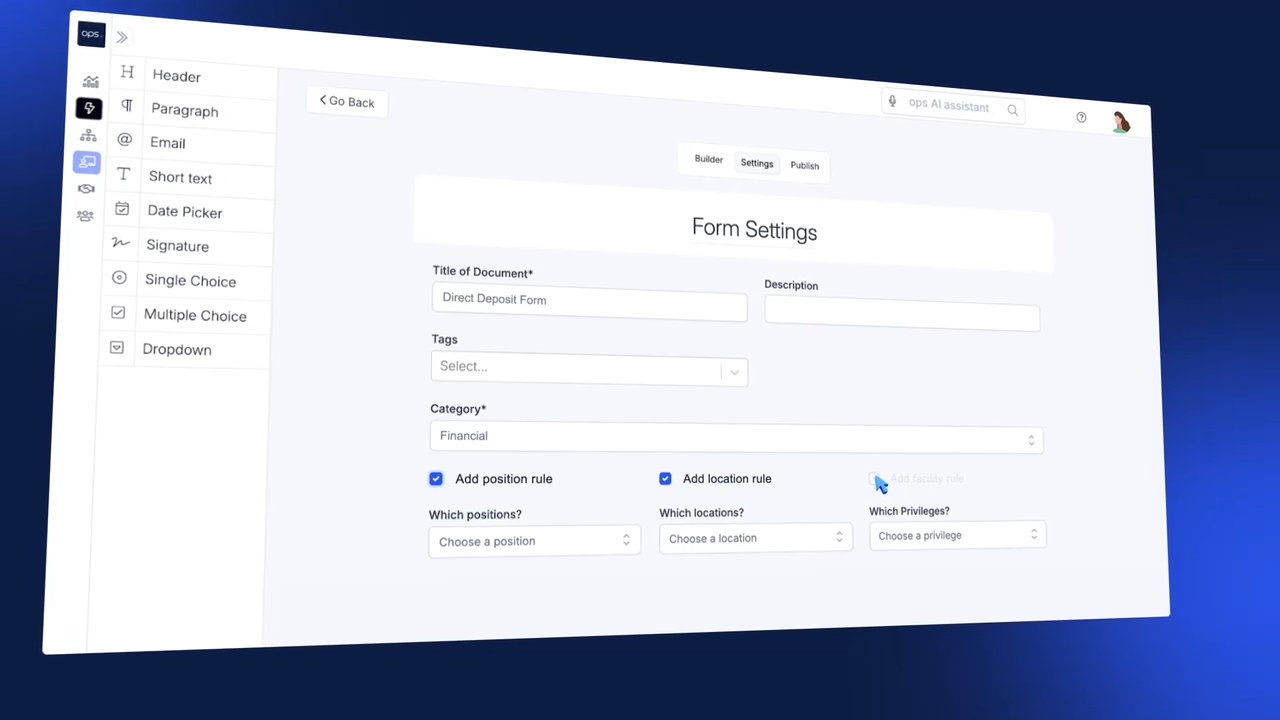
Medical practice management tools such as ops.work help facilities create, assign, and analyze feedback collection tools such as surveys and engagement forms. Explore thousands of survey templates with our free plan.
What are the Best Practices for Onboarding Medical Social Workers in Healthcare?
Onboarding effectively is the best way to keep your employees engaged. If this is their first job, it can influence how they view their career, including their willingness to stay.
Here are the best practices to help you build an onboarding program that reduces turnover and improves employee productivity:
- Prepare to onboard new workers before their first day
- Create a comprehensive roadmap for the next 30, 60, and 90 days. Share the plan with new workers so both of you are on the same page on what should be happening throughout the onboarding period
- Use technology to simplify your processes, reduce your onboarding time, and save costs
- Create opportunities for interpersonal relationships to facilitate collaboration within your team
- Invest in employee well-being initiatives, as social work can be psychologically demanding. This may include referrals to mental health professionals.
Conclusion
Done well, onboarding lays the foundation for employee engagement, improved organizational performance, and better ROI on your recruitment efforts. Tools such as ops.work help you reduce onboarding costs while building a productive, engaged workforce. Get started with our free plan.
References
Falcone, Paul. “Effective Onboarding Should Last for Months.” Www.shrm.org, 24 Apr. 2018, www.shrm.org/topics-tools/news/talent-acquisition/effective-onboarding-last-months.
Danielle Davidson, Rosalyn Darracott, Learning by Stealth: Newly Qualified Social Workers’ Experiences of Navigating Health and Hospital Social Work, The British Journal of Social Work, Volume 54, Issue 3, April 2024, Pages 1340–1355, https://doi.org/10.1093/bjsw/bcae007
Carnahan, Rebecca. “Tackle the First 90 Days of Your next Role: A 5 Step Process for Success on the Job - Alumni - Harvard Business School.” Www.alumni.hbs.edu, 20 Apr. 2023, www.alumni.hbs.edu/careers/blog/post/tackle-the-first-90-days-of-your-next-role-a-5-step-process-for-success-on-the-job.
Frequently Asked Questions
Some of the challenges you may encounter include role ambiguity and heavy workloads. Your private practice can resolve this by gradually increasing a worker's workload in alignment with their training to facilitate faster ramp-up.
A well-structured onboarding process improves employee engagement, productivity, and patient satisfaction in clinical settings.
Your workers should be trained on electronic health records, ethical standards, regulatory requirements such as HIPAA, and skills such as communication, cultural sensitivity, and emotional resilience.
Shadowing allows new staff members to gain hands-on skills in care work during the first few weeks on the job.